
Stop Ruining Good Cakes with Bad Cake Care Habits

You have spent hours baking and decorating a cake, so the last thing you need is poor cake care to spoil it before serving time.
A refrigerator may dry out the edges of your cake, a bumpy ride may ruin its layers, and condensation can affect its decorations. However, these cake care problems can be easily avoided by knowing how to properly store, transport and handle a cake.
It doesn’t matter if you want to store your recently baked sponge, freeze cake slices for later, or transport your celebration cake somewhere else, there are some basic steps you can take to ensure your cake remains perfect.
From the very second that your cake comes out of the oven until you cut your first piece, here’s all that you need to know about cake care.
Keep Your Cake at the Right Temperature
We all tend to put each and every cake in the refrigerator as soon as it is made, but this might not be the best thing to do in some cases. There are many things to take into consideration when it comes to cake storage; this includes the ingredients used in the cake and the surrounding temperature.

Sponge cakes, those covered with buttercream or with fondant especially for celebrations, can generally be left at room temperature for the first two or three days. If you are following a buttercream recipe, keep in mind that it will depend on the components you use. However, the fridge has the effect of drying out the sponge and causing the fondant to sweat, so that it may become sticky when the cake is then brought back to room temperature.
The use of a Teflon Oven Liner at the base of your oven while baking ensures that you get a constant bake temperature and prevents scorching of the base, which is one of the biggest causes why sponges go stale quicker than usual while being stored.
When to choose refrigeration:
- The cake contains fresh cream, cream cheese frosting, or custard fillings
- When the ambient temperature is more than 20 degree Celsius
- When the cake has fresh fruit decoration and you need to keep it safe for consumption
Always cover your cake and keep it separate from food items which have a strong smell, as sponge cakes easily take up their odour.
Store Your Cake Properly
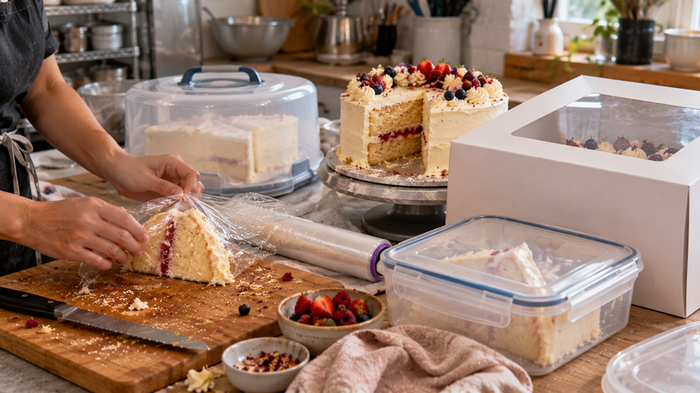
Proper cake storage begins the moment you start cutting the cake, and not at the point you store it.
When you have cut a slice, place the clingfilm straight against the exposed sponge before putting the lid on; this will prevent the cut surface from drying out overnight.
Cake storage tins are suitable for everyday cakes that you intend to eat within a few days; make sure that the tin has enough room so that the lid doesn’t come into contact with the decorations. For tiered or shaped celebration cakes, a White Window Cake Box or a similar-sized cake box can be used to keep the cake stable while at the same time protecting the decoration during storage or transport.
You can use an airtight cake container as well, which will prevent the sponge from drying up, because of the lack of contact with the air.
Freeze Cake for Later

If you want to set some cake aside for later, then Freezing cake will keep your baked goods in good condition for a lot longer, and sponge cakes tend to freeze very well.
For freezing cake slices:
- Ensure that your sponge has cooled before you freeze it.
- Put each slice individually into clingfilm and then into foil.
- Label each slice with date and flavor.
- It can be frozen for a maximum of three months.
- Allow two to three hours for thawing, but do not use the microwave.
Cakes that have buttercream or ganache on them can also be frozen, but those covered with fondant are less suitable since the fondant may become wet, sticky, or discoloured when it thaws.
Transport Your Cake Safely
The first step in learning how to transport a cake safely is to have everything ready before you leave the kitchen.
- Put the cake on a board which is bigger than the base of the cake in order to achieve greater stability.
- Place a non-slip mat under the board inside the box to prevent it from sliding about.
- Place the cake on a flat surface in the car and never put it on a seat.
- Try to keep the car cool and avoid any sudden braking.
Cakes which have tiers must have internal dowels put in place before they are moved; otherwise the upper tiers may compress or shift as a result of the movement and the whole cake will end up leaning.
A Make and Bake Loaf Tin Liner will make the job of transporting the loaf type cake much easier. Using a good cake board for each level ensures that every level of the cake is stable during transport.
Allergy Information and Labelling
In case you are selling cakes or providing them to customers in the UK, allergy information is something that has to be included in your labelling.
It will be important for you to declare the many different allergens which may be present in the cakes such as gluten, milk, eggs, nuts, and soya. Make sure there is a clear ingredient list which will enable customers to determine the ingredients used in the cake. For cakes supplied to any event, venue or client, make sure that the allergy information is easily available and be prepared to give answers on cross-contamination.
Keeping Decorated Cakes Looking Their Best
Since you’ve taken the time into cake decorating, you’ll want the details to appear nice when it comes to serving time.
- You should keep cakes covered with fondant from direct sunlight since the colours can fade quickly.
- Do not put sugar flowers or wafer paper decorations on cold surfaces since condensation could then form.
- Cakes with airbrushed decoration should not be refrigerated since condensation may cause the colours to bleed.
- Store decorated cakes in a dry room where the temperature remains between 16 and 20 degrees.
If you have done lustre dusting or edible paints, ensure that the decoration is dry before you start doing the decorations. Low humidity levels help the finishing remain longer. Super Gold Premium Luxury Edible Lustre Dust will last longer when used on a dry decoration than a moist one.
Keep Your Cake Looking Its Best
You have tried your best to make your cake. Why should you allow improper storage and handling ruin your efforts in the final process?
Cake care depends on some basic practices. The most important are proper storage, correct cutting of the cake, freezing cake pieces, proper transporting and labeling of the ingredients. All of these practices will help preserve the quality of the cake that you have created with so much effort.
Cake storage, packaging, boards, and other decorating items can be useful for making your everyday work easier. From the moment your cake is taken out of the oven to its last piece being eaten, cake decorating supplies can help you with everything.
Comments are closed here.